
Economic Modeling Software
Dynamic models for forecasting policy impacts across regions, industries, and populations.
About REMI
Founded in 1980, REMI builds dynamic economic and demographic models that help federal, state, and regional decision-makers test the effects of policies before they are implemented.
Our Mission
The Leading Local, State, and National Economic Policy Model
From the start, REMI has sought to improve public policy through economic modeling software that informs policies impacting our day-to-day lives.
We were founded in 1980 on a transformative idea: government decision-makers should test the economic effects of their policies before they’re implemented.
At REMI, we’re inspired by a single goal: improving public policies.
Our models are built for any state, county, or combination of counties in the United States.
Our commitment to a better understanding of the economy drives our unceasing process of innovation in economic theory and practice, software development and application, and the use of quantitative economic analysis to guide policy decisions.
Our economic consulting services include a range of support options that empower you to make informed decisions and minimize risk supported by dynamic economic modeling.
We are proud of the pioneering work that our clients have done and continue to do, and their ongoing contributions to informing and guiding the policy-making process.
Company ResourcesOur Leadership·REMI Overview·Company Brochure
What We Do
Dynamic models for forecasting policy impacts across regions, industries, and populations.
Support for agencies, researchers, and organizations evaluating complex economic and policy decisions.
Peer-reviewed modeling methods grounded in regional economics, macroeconomics, and demographic data.
History
From early regional modeling research to nationally used policy analysis tools, REMI has spent more than four decades advancing the way decision-makers evaluate economic change.
1977-1984
Dr. George Treyz works with pioneers in econometric modeling and helps develop the Massachusetts Economic Policy Analysis model, one of the first regional macroeconomic models. REMI is founded in 1980 to build regional forecasting and policy analysis models for public policy decisions.
1985-1993
Major research projects expand the core REMI model into a more comprehensive representation of regional economies. REMI publishes influential work in leading economics and regional science journals, helping establish the model as a standard for economic policy analysis.
1994-1999
REMI develops the first multi-regional United States model covering the fifty states and Washington, D.C. In 1997, REMI releases Policy Insight, advancing regional modeling with an intuitive graphical interface.
2000-2009
REMI implements New Economic Geography theory — a first for regional policy analysis models — deepening how its models capture the economic linkages between regions. The company introduces TranSight, connecting travel demand models with regional macroeconomic analysis.
2010-2019
The model lineup grows with Tax-PI, for evaluating the total fiscal and economic effects of tax policy changes, and E3+, for analyzing initiatives in the energy and environmental sectors. Model coverage expands to metropolitan areas and any county or combination of counties in the United States.
2020-Present
REMI marks four decades of informing policy decisions with dynamic economic modeling. In 2025, the company launches PROSERIS, a browser-based platform that delivers trusted, dynamic REMI analysis at an accessible price — with a guided workflow that opens credible impact analysis to users beyond professional economists.
Our Approach
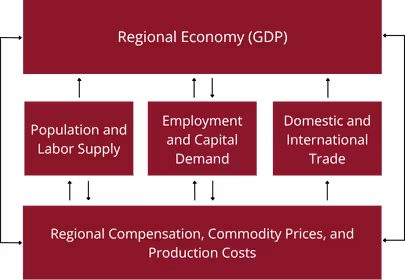
REMI models compare a baseline forecast against alternative policy scenarios, helping decision-makers isolate the economic, demographic, and fiscal effects of specific choices.
Produce year-by-year forecasts that show how effects build, phase in, and play out over time rather than a single static estimate.
Track how population, migration, and the labor force shift across regions as economic conditions and opportunities change.
Capture how wages, prices, and regional competitiveness adjust to economic change, reflecting feedback effects instead of fixed conditions.
The Pennsylvania Independent Fiscal Office (IFO) utilized the REMI model to evaluate a proposal to eliminate school district property taxes and replace the revenue with increases in income and sales taxes.
Every year, the Nevada State Demographer at the Nevada Department of Taxation uses the REMI model to forecast 20-year population projections for Nevada and its counties.
Multiple organizations in Kansas, as well as MITRE Corporation, all collaborated to conduct the 2025 Kansas AAM (Advanced Air Mobility) economic impact study.
Offices
Research, development, and modeling headquarters
Policy, consulting, and client engagement
Explore REMI’s models or connect with our team to discuss the analysis your organization needs.