1: AI is Driving an Unprecedented Surge in Electricity Demand
In recent years, artificial intelligence proliferating across the US has driven unprecedented investments in data center infrastructure. Amid data center buildouts, energy consumption surged in certain geographical regions. The International Energy Agency (IEA) estimates that since 2017, global data center electricity consumption grew by roughly 12% per year. Moreover, electricity demand is forecasted to continue rising, with the U.S. Department of Energy predicting 15-20% growth in the next decade.
This additional demand raises an important question for economic developers and decision makers: What are the economic implications of different approaches to powering data centers?
While soaring electricity demand can spur local and national economic growth, the reality is often more nuanced, hinging upon how individual data centers are powered.
2: Why Power Supply Matters
Data centers aren’t like typical commercial buildings. A single campus can rival a mid-size city’s electricity use, as they are always on load: servers, storage, and networking draw power continuously, not just at peak hours. Furthermore, cooling systems consume additional energy. As such, the enormous energy demands of data centers engender broad economic implications in the surrounding regions.
How data centers are powered can dramatically change their economic impact on surrounding communities, each with unique benefits and drawbacks. If the electricity draws from an already constrained grid, consequences differ from adding new generation capacity to the local grid with grid-interactive agreements.
Multiple energy sources can power data centers. In 2024, the IEA reported that natural gas supplied over 40% of electricity for U.S. data centers, renewables such as wind and solar supplied 24%, nuclear power supplied 20%, and coal around 15%. Some developers pair new data centers with dedicated generation sources, including renewable projects, nuclear power, or other new generating capacity, to reduce pressure on existing grids.
3: The Economic Tradeoff
3.1: Jobs, Investment, and Tax Revenue
The data center boom can generate economic prosperity for Americans living near them, creating thousands of jobs in construction, boosting local labor markets and government revenue, and attracting other companies to the community. Yet, job creation can quickly become a snapshot in time. During the operational phase of data centers, buildings can run with less than 50 technicians, and data centers demand far fewer long-term jobs once built. Still, it is important to understand and model the ripple effects of a new data center on other industries in the area.
AI routed to data centers incurs more CO2 emissions than traditional internet use, burning fossil fuels. In addition to undermining climate goals for renewable energy, powering data centers with non-renewables may strain local water and energy resources, increase electricity prices, and make a region less desirable to live in. All of these can cause outward migration and reduced inward migration to a region. As a result, the economic health of the locality can decline, despite the job creation caused by data centers.
3.2: Utility Bills May Rise for Local Residents
When data centers extract energy from the local grid, their concentrated demand can strain power grids and propagate utility price hikes for neighboring households and small businesses. The costs of expensive upgrades to the electric grid and other grid reliability problems can be borne by all utility customers connected to the grid, unless lawmakers require technology companies to cover power bill cost increases through upfront payments and new rate-paying classes.
Across the United States, private residents have already been footing the bill for electric grid upgrades to satisfy the voracious power demands of data centers.
3.3: CO2 Emissions and the Environment
For climate-conscious residents, data centers also pose a moral quandary around environmental impacts when powered by non-renewable energy sources such as fossil fuel. The greenhouse gas emissions of several big technology companies spiked after a proliferation in AI usage. Decisions on energy sources for these facilities can palpably contribute to discontent over climate change and thwart the net-zero climate pledges of big technology companies.
Furthermore, constant noise can cause a population exodus from the local area, directly affecting the economy and the ability for local companies to attract satisfied and skilled workers.
4: Comparing Two Development Scenarios
In a recent webinar, REMI analysts modeled a large California data center under two different electricity supply strategies. In the first scenario, electricity from the existing grid powered the facility, increasing pressure on local infrastructure, and incurring negative amenity and non-monetary economic effects. In the second, a new power plant was constructed alongside the data center, avoiding many of the negative spillover effects associated with grid congestion.
4.1: Scenario One: Energy from the Local Power Grid
Accounting for construction investment, operations, and non-pecuniary amenities, the REMI’s PI+ model forecasted the economic impact of a 1.5-2 million square foot data center, modeled with a negative amenity aspect to show how noise, pollution, water consumption, and the depletion of local power grid resources can make the region unattractive and degrade the quality of life of residents near data centers, spiking greenhouse gas emissions.
4.2: Scenario 2: Energy from A Renewable Power Plant
For the second scenario, REMI Models analyzed the same California data center, except that it pulled power from a small modular reactor and renewable energy source, rather than the local power grid. Because the renewable power plant generates additional energy, the negative amenities are omitted. In this case, AI’s energy consumption spurs local and national economic gains, ushering in a new industrial anchor, funding new public facilities, and cultivating new jobs. However, the construction of the small modular reactor incurs additional upfront costs.
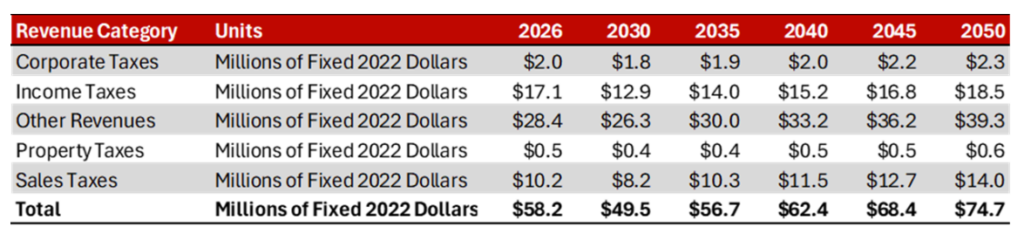
Taken from REMI’s PROSERIS interface, the following graphs display several economic impacts of constructing and operating the data center in California according to the plans of the second scenario. 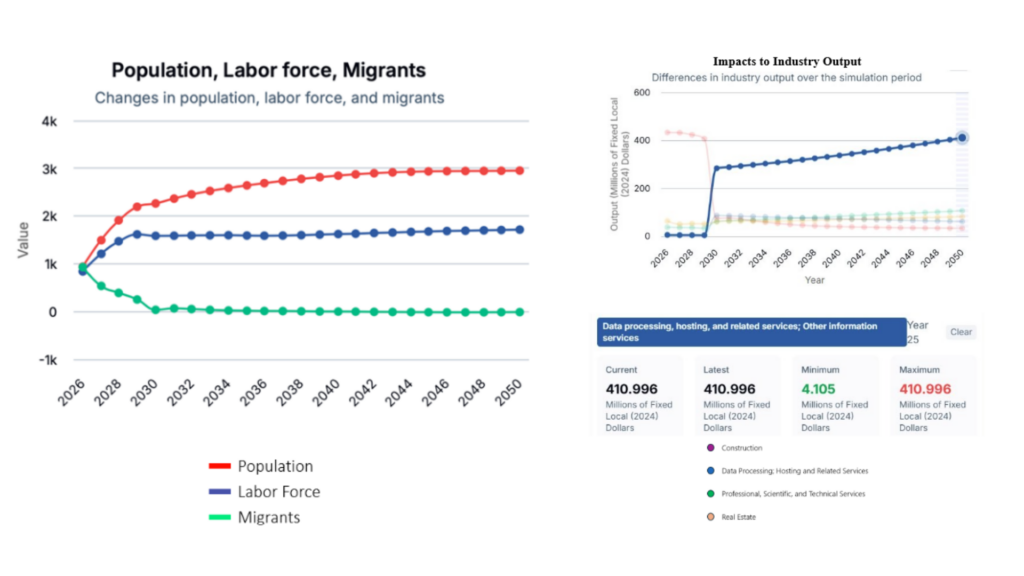
4.3: Analyzing the Comparison
In the first scenario, between the construction and operation phases, GDP and personal income decreased, and the locality lost about 504 jobs. REMI’s analysis points to a population decline, likely due to hikes in utility bills and other non-pecuniary aspects such as noise pollution and environmental sustainability.
In the second scenario, during the operation phase, the locality experiences growth in output, population, labor force, an increase in tax revenue, and better population retention. Such differences can be explained by whether the data center congested the electric grid.
5: Why Economic Modeling?
When considering the power sources of a data center, companies and local decision makers must weigh a variety of factors: from how households and small businesses may foot the mounting electricity bills due to new data centers, the environmental costs, and the economic growth and advancements in utility companies’ sustainability commitments. Understanding these interlinked factors, including negative amenities, and their effect on the economy requires substantial modeling.
At a time of heightened skepticism from locals, bidders for grants and contracts from data centers and power plant development will need to demonstrate how their proposals positively impact host communities via measurable outcomes. Economic developers should leverage data-driven decision-making to substantiate infrastructure investment and make compelling cases for development. To do so, software that can clarify, calculate, and communicate a quantitative narrative to policymakers is critical.
Not only can economic modeling help agencies forecast the complex effects of policies before they are implemented, but it also guides the decision-making process and adds quantitative rigor to proposals.
6: How REMI Can Help
REMI’s dynamic models enable analysts to forecast the impact of infrastructure investment, buildout, and deployment scenarios over time.
Interested in evaluating how data center and energy infrastructure investments could affect your regional economy? Learn more about REMI’s models or book a demonstration.
Watch a recent REMI webinar on the economic implications of rising energy demand from data centers.
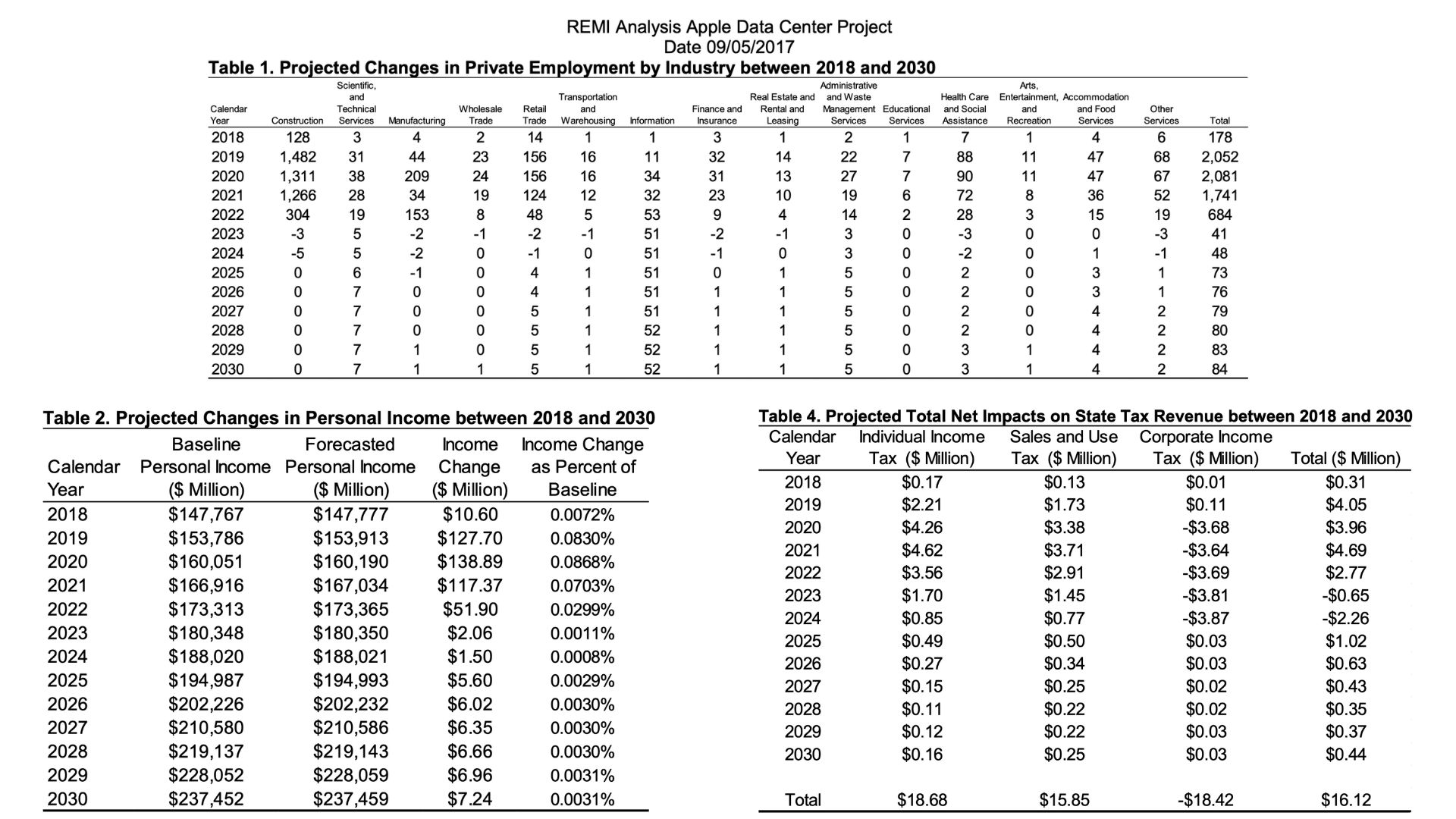
View a past study on the economic implications of the construction and operation of a proposed Apple Data Center, which used REMI.
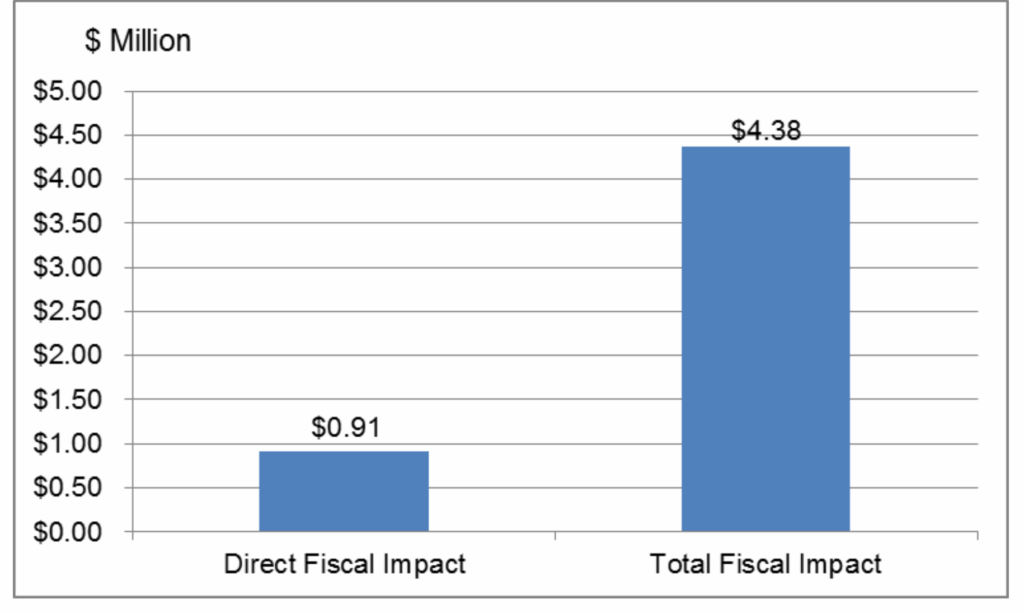
Using REMI’s Tax PI model, the Iowa Department of Revenue analyzed the economic implications of an Apple Data Center project proposed by the Iowa Economic Development Authority. Accounting for year-by-year construction, equipment, and computer equipment costs, REMI’s Tax PI model projected changes in private employment, personal income by industry, state tax revenue (direct net and total net), and direct and total fiscal impact in the Waukee, Iowa community.
Net Present Values of Direct Fiscal Impact and Total Fiscal Impact, 2018-2030