
1: In July, the United States declined to extend the USMCA.
On July 1, 2026, the US-Mexico-Canada Agreement (USMCA) Free Trade Commission held its six-year joint review of the Agreement. In it, the United States declined to extend the USMCA for an additional 16-year period, citing widening trade deficits with Mexico and Canada, among other grievances. This decision triggers a series of annual reviews, which the three signatories will engage in until the agreement expires on July 1, 2036, or until one party withdraws on six months’ notice.
1.1: What is the USMCA?
Envisioning a modern replacement for the 1994 North American Free Trade Agreement (NAFTA), trade officials negotiated the USMCA under President Trump’s first term.
The United States-Mexico-Canada Agreement (USMCA) is a trilateral free trade agreement (FTA) that secures duty-free trade between the three eponymous countries and updates regulations for cross-border e-commerce, digital services, intellectual property, and other non-tariff issues. The USMCA rights and obligations also outline preferential tariffs, rules of origin, investment protections, and dispute settlement mechanisms.
1.2: Why does the USMCA matter?
Now underpinning almost $2 trillion in annual trade, the USMCA plays a vital role in the US economy. Canada and Mexico are the United States’ two largest trading partners. These northern and southern neighbors sustain US manufacturing, agriculture, and energy sectors and account for much of the direct investments in US companies.
In 2019, the United States International Trade Commission (USITC) estimated that the USMCA would likely have a positive impact on US trade and all broad industry sectors within the US economy, boosting real GDP by $68.2 billion (0.35 percent) and US employment by 176,000 jobs (0.12 percent).
However, because the Trump administration did not opt to renew the USMCA, the free trade agreement is more likely to lapse in ten years, potentially raising consumer prices and reducing estimated positive impacts. Given these impressive stakes, any changes to the USMCA warrant close attention to the trade pact’s regional economic implications.
1.3: What happens now?
Since the United States did not extend the Agreement at the joint review, Article 34.7.4 activates two immediate responses:
Annual joint reviews:
The Free Trade Commission must now conduct a joint review every year for the remainder of the trade deal’s 16-year term. Parties may also choose to address points of contention through bilateral and trilateral meetings separate from the joint review process. Since May, the U.S. and Mexico have already undergone three such renegotiation rounds.
“At any time” extension pathway:
Under Article 34.7.4, if the US, Canada, and Mexico confirm their intentions to extend the USMCA in writing through their heads of government, they may reinstate the 16-year extension at any point before the expiry date.
Terminating the USMCA would likely have a major impact on the US economy, resurrecting most-favored-nation (MFN) tariffs between the partners that currently average around 3 percent for US MFN tariffs, 6 percent for Canadian MFN tariffs, and 7 percent for Mexican MFN tariffs.
Importantly, though, the current non-renewal is not a termination. The agreement remains fully in force for the near term. However, renegotiation could spur on business uncertainty and long-term risks, affecting North American supply chain relationships once facilitated through the USMCA and NAFTA. Moving forward, the three parties may adopt more stringent supply chain standards, content requirements, and rules of origin.
2: How might declining to renew the USMCA impact the US economy?
While the United States did not terminate the USMCA, failing to extend the agreement beyond its expiration date could create another type of economic distress: trade policy and business uncertainty. It begs the question: how would failure to renew the USMCA affect the US economy?
2.1: Lowering foreign and domestic investment
Stalling USMCA renewal, or worse, terminating the agreement completely could increase tariff policy uncertainty. This added turbulence has already spurred Canada and Mexico to diversify their trade ties away from the United States and toward Europe and China. Yet geography still reigns in decision-making, and the United States remains a key trading partner for both countries.
At the same time, uncertainty and choppy waters can impel businesses to withhold future investment. Such a standstill in new manufacturing and warehousing space may impact American jobs and the competitiveness of the North American economy as a whole.
2.2: Shrinking the US economy
Trade deals can prove indispensable, forming the backbone of a healthy US economy. Roughly 2 million US jobs depend on trade with Canada and Mexico. Hence, curtailing free trade agreements with US neighbors could harm the economy, as shown by recent tariffs imposed on Canada and Mexico.
In February 2025, President Trump enacted 25 percent tariffs on most imports from Canada and Mexico. Exemptions for USMCA-covered imports – amounting to almost $800 billion in USMCA-compliant trade, or 85 percent of Canadian and Mexican exports – partially insulated US importers from the tariff shock,
The Tax Foundation modeled the economic impact of these tariffs with the USMCA exemptions. For the scenario of a 25% tariff on USMCA auto and auto parts imports and a 10% tariff on all other USMCA imports, the study revealed that despite the USMCA exemptions, the tariffs currently in place are on track to cost American households about $700 in 2026 and reduce long-run GDP by 0.3 percent. Moreover, ending the USMCA exemptions for tariffs would reduce long-run GDP by an additional 0.1 percent, translating to 95,000 jobs lost.
3: Which states and products are most exposed to USMCA revisions?
The following tables from the Peterson Institute for International Economics display US exports to Canada and Mexico by region and state. Regions bordering the northern and southern US are most exposed in the event of a USMCA renegotiation. 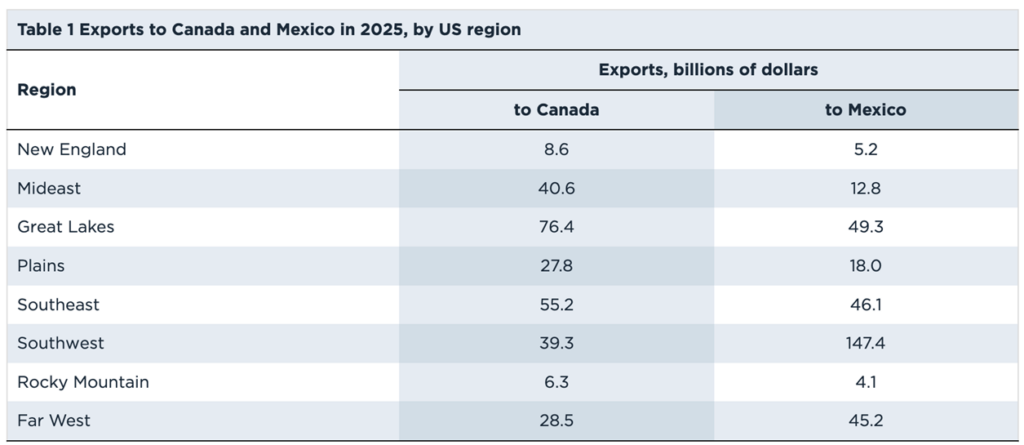
Sources: US Census state exports HS 6 (origin of movement) and US Bureau of Economic Analysis GDP by state.
Notes: Exports in this table do not include exports to Puerto Rico or the US Virgin Islands, as well as those without a specified origin of movement. The Mid-Atlantic region covers Mid-Atlantic states such as New York, New Jersey, and Maryland. More details are available through the Bureau of Economic Analysis regions by state.
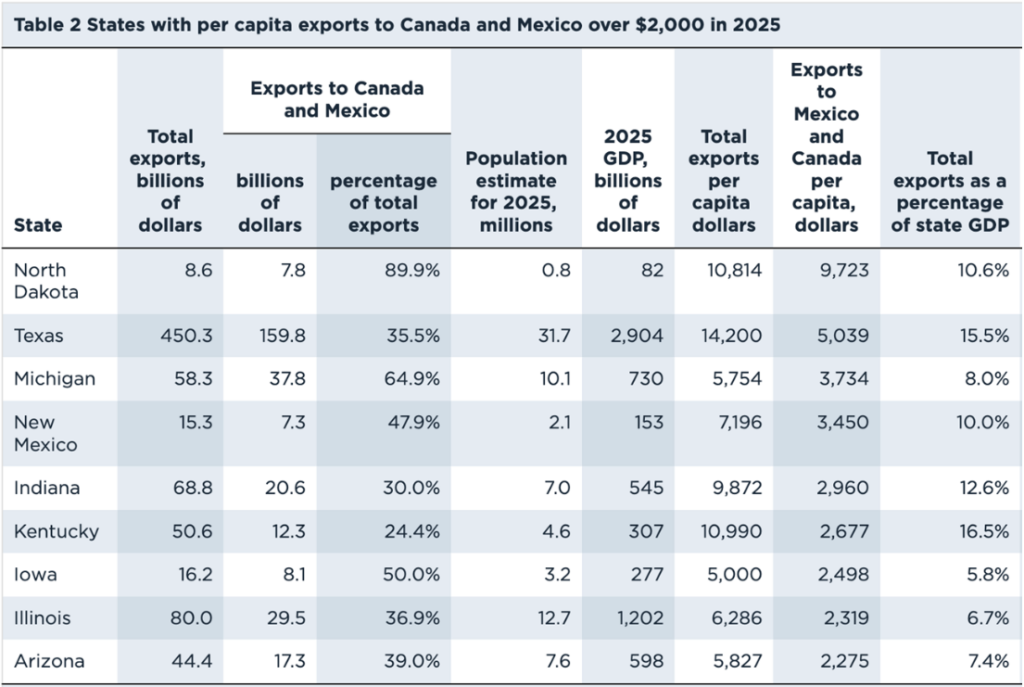
Sources: US Census state exports HS 6 (origin of movement), American Presidency Project (University of California, Santa Barbara), and US Bureau of Economic Analysis GDP by state.
Table 3 illustrates nine product categories highly affected by the USMCA. In each, US exports to Canada and Mexico combined exceeded $10 billion in 2025. US producers dealing with these products should monitor the economic implications of any USMCA negotiations and tariffs, as well as their current sourcing, compliance, production, storage, and distribution operations.
Notably, 75.6% of automotive product (8708) exports are transported to Canada and Mexico.
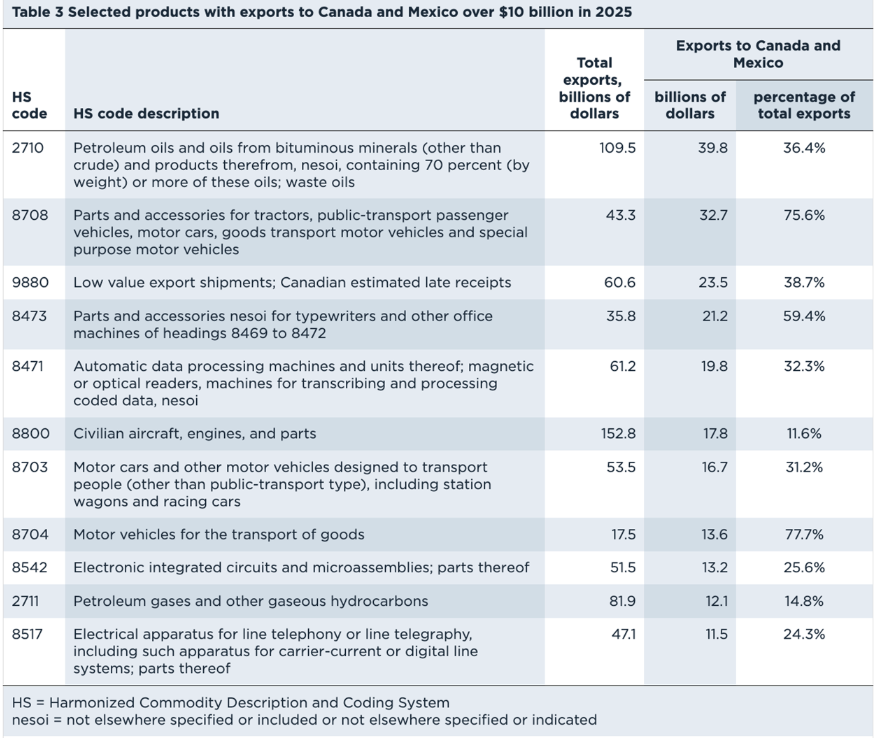
Source: US Census state exports HS 6 (origin of movement).
4: How might annual reviews revise the USMCA?
4.1: What issues is formal renegotiation expected to address?
The US, Canada, and Mexico plan to continue discussions through formal, annual renegotiation. Taking place from May 28-30, June 16-17, and July 21-23, 2026, the first three bilateral U.S.-Mexico renegotiation rounds have already advanced discussions on the automotive sector. In particular, the talks focused on rules of origin, economic security, steel, and aluminum.
Additionally, in his December 2025 meetings with Congress, US Trade Representative Jamieson Greer raised additional topics for joint reviews. Beyond the automotive industry, upcoming renegotiation is likely to cover several broader areas:
- Investment and supply chain security: Coordinating foreign investment screening to curb Chinese circumvention, enforcing forced-labor restrictions, and limiting Chinese-linked technology in vehicles;
- Agricultural trade: Resolving disputes involving genetically engineered corn, agricultural biotechnology, Mexico’s grain reinspection practices, and tariff rate quota allocations for Canada’s dairy market;
- Bilateral trade issues with Canada: Dairy, digital services, and provincial bans on the distribution of US alcohol;
- Bilateral trade issues with Mexico: Concerns with Mexico’s state-owned enterprises, labor, and energy sector market access;
- Stronger compliance rules and revisions to the rules of origin;
- Tariffs on Canadian and Mexican goods under the International Emergency Economic Powers Act;
- Global national security tariffs under Section 232 of the Trade Expansion Act of 1962 that affect key Canadian and Mexican sectors.
4.2: How could Congress alter the USMCA?
Changes to the USMCA may come not only from formal renegotiation, but also from legislation within each member country. As the branch that is constitutionally authorized to regulate commerce with foreign nations, Congress must approve revisions to the USMCA.
In the United States, for example, Senators Katie Britt and Tim Scott introduced the Foreign-Trade Zone Export Enhancement Act of 2026. The proposal would permit qualifying goods manufactured in U.S. foreign-trade zones to enter Canada and Mexico without duties, altering the treatment of certain exports under existing USMCA rules.
Currently, manufacturers using these zones may still owe duties on non-originating components incorporated into products shipped to Canada or Mexico. Eliminating those duties could make U.S. foreign-trade zones more competitive and influence how companies structure their sourcing, production, storage, and distribution operations. The potential benefits could extend to businesses using bonded warehouses and other duty-deferral arrangements.
Companies should therefore look beyond the formal negotiations among the United States, Mexico, and Canada. Domestic legislation and regulatory changes may also carry important consequences for USMCA compliance, operating costs, and long-term supply-chain strategy.
5: How should companies respond to USMCA revisions?
5.1: Why regional economic modeling?
Given the wide-sweeping implications of the USMCA review process and domestic legislation – whether for rules of origin, regional content, supply chain security, or sector-specific market access – a cloud of uncertainty now shrouds the long-term trajectory of the USMCA. Companies exposed to North American trade must evaluate possible policy changes against their current sourcing and compliance strategies. In such a case, regional economic impact analysis can prove critical, allowing users to project how trade policy affects business operations and their regional economies.
Regional economic analysis is especially important because the effects of a revised or terminated USMCA would not be distributed evenly. Some regions could benefit as production shifts toward domestic suppliers or creates new opportunities for nearshoring, reshoring, and capital investment. Others could experience reduced exports, higher input costs, supply chain disruptions, or declining competitiveness. The outcome for each region would depend heavily on its industry mix, cross-border trade, workforce characteristics, and relationships among suppliers, producers, and consumers. In other words, changes to the USMCA would likely produce both regional winners and losers.
6: How can REMI help with economic impact analysis?
6.1: How can REMI help?
REMI (Regional Economic Models, Inc.) provides leaders with dynamic economic modeling tools to compare alternative USMCA scenarios and analyze the regional economic impact of policies, projects, and investments through 2060.
To do so, REMI captures inter-industry relationships, economic geography, labor market behavior, migration, demographics, peer-reviewed econometric equations, and a compilation of datasets from trusted federal and state agencies. These forecasts can help stakeholders identify which communities may be most exposed and develop more informed strategies for long-term regional economic growth.
Interested in evaluating how USMCA renegotiation affects your regional economy? Explore different REMI models or book a demonstration.