
Studies
Commissioned economic analysis from 46 years of practice.
Explore REMI’s policy research library of more than 310 studies across energy, transportation, tax and fiscal policy, labor, and more. Authored by federal and state agencies, research institutes, universities, and consultants who use the REMI modeling suite.
Trusted by agencies at every level
Rigorous analysis. Real-world impact.
Decisions informed by evidence.
Supporting better policy outcomes.
Featured Studies

Consulting & Advising
Economic and Fiscal Impacts of Medicaid Expansion Reversal in Ohio
The “One Big Beautiful Bill” passed recently by the House of Representatives significantly cuts federal funding for Medicaid. It is uncertain how these cuts will affect the program…
Read study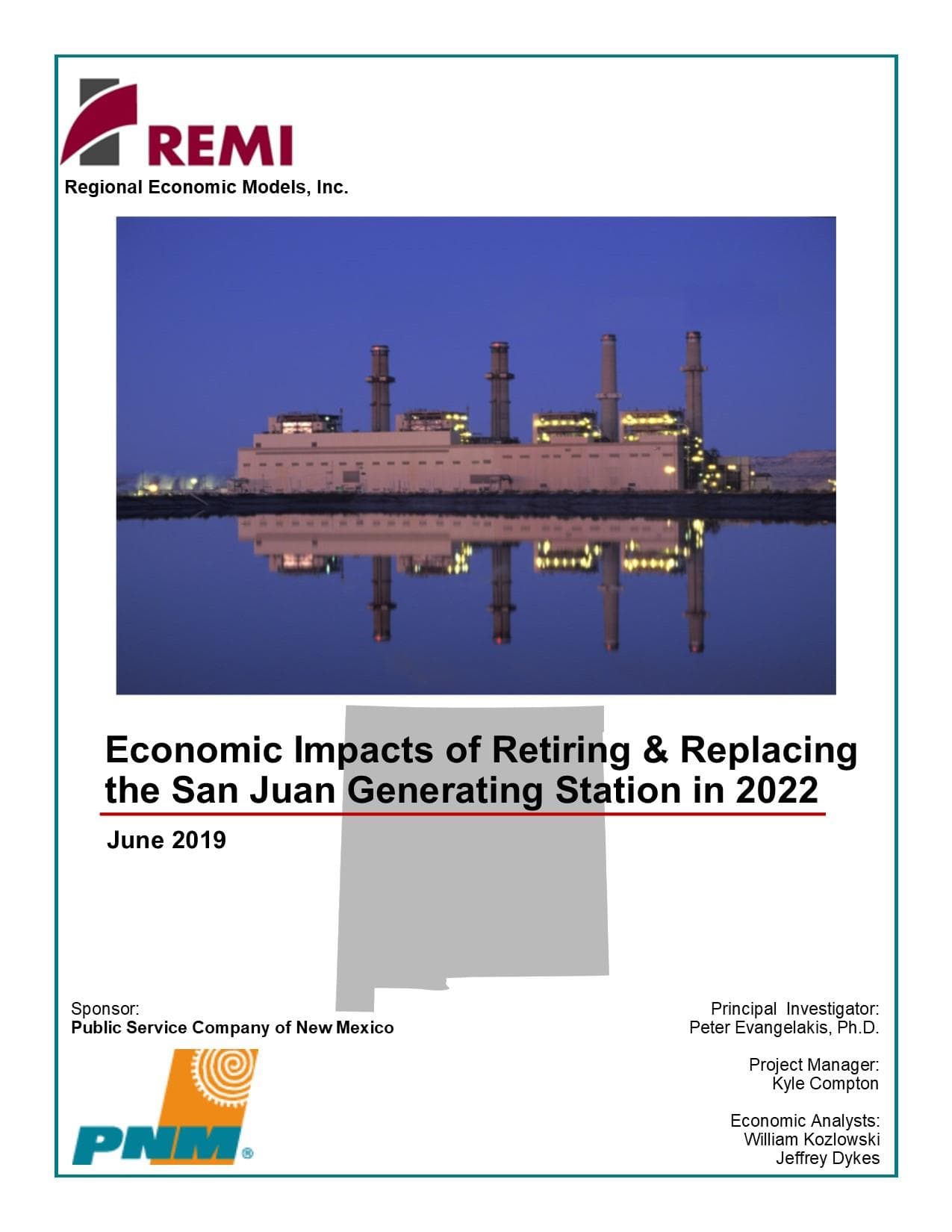
Consulting & Advising
Economic Impacts of Retiring & Replacing the San Juan Generating Station in 2022
The Public Service Company of New Mexico (PNM) has entrusted REMI to analyze the economic and demographic impacts of retiring the coal-fired San Juan Generating Station (SJGS), loc…
Read study
Consulting & Advising
The National Economic Impacts of Current Legislative Proposals to Change the Capital Gains Tax
REMI was entrusted, by the Committee to Unleash Prosperity (CTUP), to perform a national economic impact analysis of the three proposed changes to the STEP Act (Sensible Taxation a…
Read study
Browse & search studies
Find the research you need.
Search our library of 310+ studies or use the filters below to narrow your results.
Examples: clean energy jobs, property tax, transportation, Colorado
316 studies found · page 21 of 22
A Study of Fort Sill Military Housing Needs
The Cameron University Business Research Center sought to understand and quantify housing needs for the Fort Sill military population by considering the changing demand of Fort Sill personnel and dependents in juxtaposition with the supply and demand conditions for housing in Comanche County, Oklahoma, and separately f…
School Funding, Taxes, and Economic Growth: An Analysis of the 50 States
REMI’s computable general equilibrium model was tasked with charting out the benefits and effects of expanding school funding across all 50 states. Over the long term, the major effects come with substantial quality of life improvements by way of regional competitiveness and workforce migration. The study also can be u…
Modeling Practices and Their Ability to Assess Tax/Expenditure Economic Impacts
This report reviewed five economic models (IMPLAN, TRAIN/Dynamic TRAIN, STAMP, DRAM, and REMI) to assess their usefulness in appraising behavioral responses as an aid to evaluating proposed tax legislation. Every model was thoroughly explained, including numbered lists of advantages and disadvantages for each. The repo…
The Waxing and Waning of Regional Economies: The Chicken-Egg Question of Jobs Versus People
This study revisits the long-debated chicken-egg question of whether people follow newly created jobs into regions or whether jobs follow newly arrived migrants with the help of economic modeling. Researchers found that labor demand shocks are deemed to be more important on average than migration innovations in determi…
The Georgia Lottery: Assessing Its Administrative, Economic, and Political Effects
The University of Georgia estimated the impacts of the lottery dollar trail on Georgia’s economy with the REMI macroeconomic model. Analysts found that the lottery has a moderate positive impact on the state in the form of new jobs and residents, but may not accrue enough revenue to fund the educational programs it was…
Global Aging: Achieving Its Potential
Life expectancy is increasing in almost every country around the globe, from the least developed to the international leaders. With this expectancy increase understood, AARP enlisted the services of the REMI model to assess the macroeconomic possibilities inherently incorporated in a longer life expectancy. AARP wanted…
The Economic Impact of Base Closure: Letterkenny Army Depot and Franklin County
Using the REMI model, an analysis of two distinct army base regions uncovered the truth about living conditions and the populations surrounding them. While unemployment numbers in these areas are respectable, the community/workforce has gotten increasingly older as wages slightly decreased overall as a result of stream…
Fort Drum Regional Economic Impact Study: Analysis of Economic Impacts of Fort Drum, NY on the Regional Economy of Jefferson, St. Lawrence and Lewis Counties
The Fort Drum Regional Liaison Organization asked a team of consultants to review data on the economic activity of Fort Drum in Watertown, New York, interview affected parties to assemble a base of data on economic activity impacts of Ft. Drum, assess regional economic impacts, using an economic model calibrated for th…
Productivity and Accessibility: Bridging Project-Specific and Macroeconomic Analyses of Transportation Investments
When it comes to transportation analysis, there are two primary perspectives typically used in the corresponding studies. The first relies on overly narrow measures of economic benefits and the second focuses on economic productivity, defines benefits more broadly, and is limited by geographic and functional aggregatio…
Regional Economic Benefits of Environmental Management at the U.S. Department of Energy’s Major Nuclear Weapons Sites
A multi-regional economic simulation model built by REMI was selected in this 1998 study to determine the economic benefits of environmental management practices set to be implemented at major nuclear weapons sites. Researchers found that the site regions that most badly need environmental management investments due to…
Searching for General Equilibrium with a REMI Model: Rural-Urban Effects of Federal Taxes, Entitlements, and Deficits
This paper was written with the intention of providing estimates of the regional demographic and economic impacts of current and proposed federal policies, identifying the most important audiences for this type of data collection, and addressing the research design for this project. The Rural Policy Research Institute’…
The Massachusetts Dynamic Analysis Model
The Dynamic Analysis Model is the combination of microsimulation and macroeconomic models used to address the critical needs of policy analysts assessing the impact of tax proposals on the economy. The REMI model was fused with a simulation model from the Tax Economics Department of Price Waterhouse to analyze economic…
A Shift in Military Spending: To America’s Cities: What It Means to Four Cities and the Nation
This report analyzed the economic impact of transferring $30 billion of outlays per year over the 1986-1990 period from the Department of Defense budget to key urban programs. Chicago, IL, Trenton, NJ, Austin, TX, and Irvine, CA were chosen as test cities for the impact of this budget decision. Although each city did n…
Using A Multi-Regional Forecasting and Simulation Model to Estimate the Effects of the Military Buildup From 1981-1985 on State Economies
The essentials of a multi-area forecasting and simulation model are displayed in this paper using the example of U.S. military buildup from the year 1981-1985. The REMI multi-regional model identified that this scale of military buildup had important differential effects on major regions’ and states’ economies during t…
Conjoining an Input-Output Model and a Policy Analysis Model: A Case Study of the Regional Economic Effects of Expanding a Port Facility
The concept of melding together two separate models to arrange the most complete economic picture possible is analyzed in this 1980 report. The MIO and MEPA models were brought together for a project evaluating the economic effects of container-port expansion at the Massachusetts Port Authority. Researchers were able t…