
Study Overview
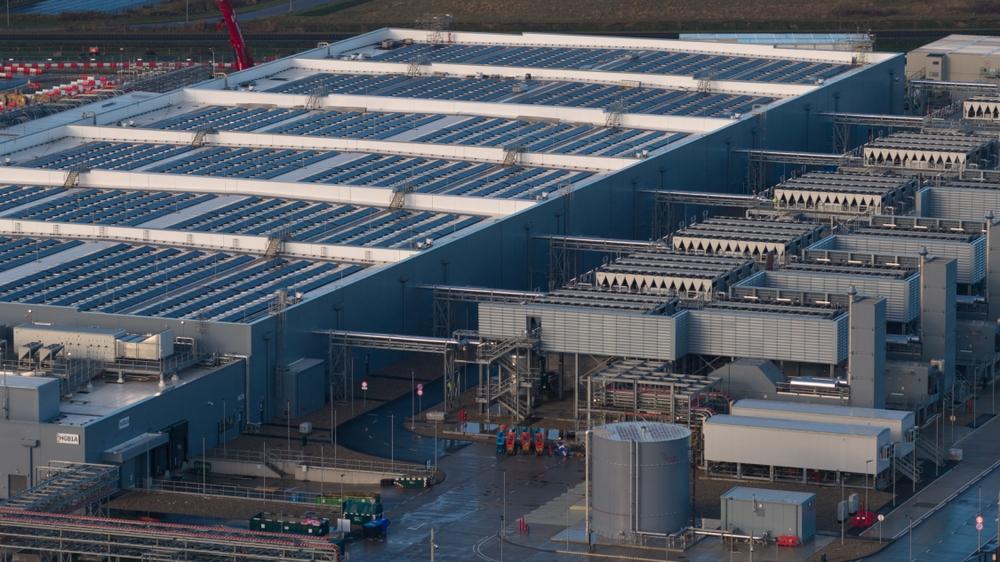
A $5 billion data center investment scenario in Lincoln County, Wyoming, illustrates how major technology infrastructure can affect a regional economy. Modeled employment peaks near 1,550 jobs during construction, while annual GDP impacts approach $195 million. Operations support a smaller, sustained economic contribution, with most of the GDP benefits concentrated in the host county.
The analysis, developed by Alexander Gebben and Bailey Kirkland of the University of Wyoming’s Center for Business and Economic Analysis, uses REMI PI+ and Tax-PI to examine economic and fiscal effects. The illustrative scenario is based on real-life projects. Its results trace effects on employment, production, and activity across industries.
For communities evaluating data center proposals, the distinction between construction and operations is essential. A large initial workforce can create immediate housing and infrastructure demands, while ongoing operations provide a different mix of jobs and economic benefits.
What Data Centers Do and Why Location Matters
Data centers house and operate computer infrastructure. Their applications include large language models, proof-of-work mining, cloud storage, hosting services, and virtual private networks. These uses have different computing and energy requirements that shape their economic effects.
Energy projections cited in the analysis indicate that global data center electricity use could roughly double by 2030. The scale of future demand depends on AI adoption and improvements in computing efficiency. Cloud storage, for example, can be less energy intensive than computationally demanding applications. Electricity requirements therefore need to reflect the particular operation being assessed.
Wyoming’s available land, cool climate, and interest in economic diversification make data center development relevant to the state. As of June 2026, ten companies operated data centers around Cheyenne, with further facilities under construction or proposed. Equipment sales tax exemptions also form part of the state’s approach to attracting investment.
Economic Benefits and Community Concerns
Large capital investments, construction jobs, operating employment, and potential tax revenue create opportunities for host communities. Higher wages and productivity gains for nearby firms may add benefits. Evaluating development also requires attention to the costs residents could face and whether economic gains remain in the community.
Electricity demand raises concerns about household bills, supply reliability, and the cost of expanding utility infrastructure. Grid-connected facilities can compete with other consumers for power, potentially increasing prices or exposing residents to infrastructure costs through their bills. On-site generation changes those relationships, so energy impacts depend on the facility’s actual power arrangements.
Water consumption is another concern, particularly in drought-prone parts of the American West. Closed-loop cooling can reduce consumption compared with evaporative cooling. However, the assessment also needs to account for water used to generate the facility’s electricity. Cooling technology and the power source jointly shape the demand placed on water resources.
Noise from backup generators can disturb nearby residents, while lighting can affect nighttime skies. These impacts may also raise concerns about nearby property values. Land occupied by a data center becomes unavailable for alternative uses. Zoning and siting policies that separate facilities from residences are potential ways to address noise and light concerns.
Housing pressure is especially important during construction. In some small Wyoming towns, large construction workforces can temporarily double the population. Without adequate accommodation, added demand can increase housing costs for existing residents. Temporary workforce housing and coordination with developers are relevant responses, particularly where several major projects overlap.
Broader concerns include AI-related job displacement and income inequality, including whether local residents share in the benefits of large technology investments. These issues, along with environmental and housing pressures, were identified as considerations for evaluation; the illustrative employment and GDP results do not quantify them or establish the project’s overall community benefit.
A Five Billion Dollar Lincoln County Scenario
The Lincoln County scenario combines a data center, natural gas power generation, and battery energy storage in a $5 billion investment. The modeling periods cover construction from 2027 through 2030 and operations from 2031 through 2060, with some overlap between construction and operating activities.
These components define the scope of the results. The employment and GDP impacts reflect computing infrastructure together with power generation and storage. Different energy arrangements could change supplier purchases, operating employment, and fiscal effects.
The scenario uses plausible capital and labor relationships informed by commissioned research. Confidentiality restrictions prevented disclosure of the underlying client project, so the example does not forecast a named development. It shows how project assumptions translate into regional outcomes relevant to investment evaluation and community planning.
Modeling Investment and Operations with REMI
REMI PI+ provides the regional economic detail, while Tax-PI supports state fiscal analysis. Eight parameters span three input categories: detailed investment, industry output, and employment. Equipment purchases include computers, other equipment, batteries, and turbines. Computer capital is assumed to be refreshed approximately every five years, incorporating recurring purchases into the analysis.
Building construction is represented through industry output, while employment inputs cover data center and power-related activities. Treating equipment purchases separately from local production helps avoid overstating Wyoming’s economic benefits. A large purchase does not necessarily support manufacturing within the state; imported computers, batteries, and turbines can generate substantial activity elsewhere.
Capacity-based employment relationships also help account for the scale of the investment. A logarithmic approach to power plant staffing avoids assuming that employment rises in direct proportion to capacity. This provides a more conservative representation of labor requirements for a large facility than simply multiplying a staffing ratio by investment size.
Other modeling considerations include electricity-demand feedback, industry classifications, rapid technological change, and purchasing locations. REMI allows customization of industry input purchases, compensation, and productivity where standard relationships do not adequately represent a facility. Relatively little custom industry adjustment was needed for this example, although other operations could require more extensive changes.
The dynamic framework holds direct operating employment constant under the scenario’s assumptions, while changes in efficiency and spending influence the wider economy. Employment and GDP can consequently follow different long-term paths after construction subsides.
Employment Peaks During Construction
Total modeled employment rises from roughly 650 jobs in 2027 to approximately 1,550 in 2030. It then falls to about 540 in 2031 and gradually approaches 370 by 2060. These figures are approximate readings from the results chart and represent annual employment impacts associated with the illustrative investment.
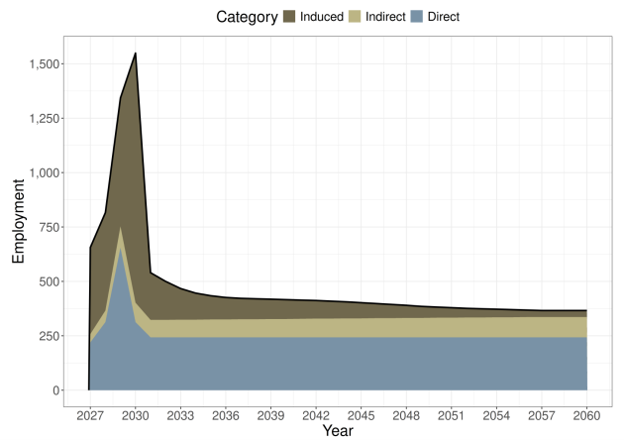
Figure 1. Annual modeled employment impacts, including direct, indirect, and induced effects. Source: Economic Impact of Data Centers, Job Outcomes, slide 14. Numerical readings are approximate.
Direct employment covers the modeled project activities. Indirect employment arises through supplier relationships, while induced employment reflects household spending supported by the income generated. The combined impact therefore extends beyond the staff operating the data center and its associated power infrastructure.
Induced effects are particularly significant during construction, when the temporary workforce and related spending generate additional economic activity. During operations, direct employment remains near 240 jobs under the fixed staffing assumption. Supplier and household spending effects keep total employment above that level, although the broader employment contribution gradually declines over time.
The approximately 1,550-job peak represents a single year’s total impact, including spillovers. It is not a permanent data center staffing figure or a cumulative count of workers. Operating positions can include server upgrades, IT maintenance, repairs, and contracted services, alongside the jobs associated with power generation.
Operating Jobs Have a Different Industry Mix
Construction and machinery manufacturing feature prominently during the development phase, alongside retail trade and technical services. This distribution reflects the activities required to build facilities, acquire equipment, and support the workforce. It also demonstrates that data center investment can affect industries beyond computing.
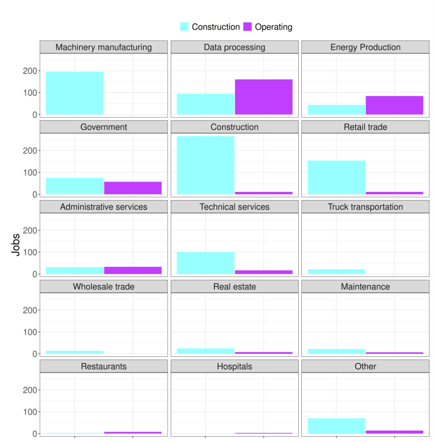
Figure 2. Employment impacts by industry during construction and operations. Source: Economic Impact of Data Centers, Job Outcomes, slide 14. The phase comparison does not specify an averaging convention.
During operations, data processing and energy production become the largest categories shown. Government and administrative services also retain employment effects, while construction employment is substantially lower. The change follows the transition from building and equipping infrastructure to maintaining computing and power operations.
The industry breakdown identifies how employment opportunities change over the project’s life. The phase comparison indicates the composition of employment rather than a cumulative number of jobs created across the analysis period.
GDP Benefits Are Concentrated in Lincoln County
Total annual GDP impacts rise to approximately $180 million in 2029 and peak near $195 million in 2030. They fall to roughly $95 million in 2031 as construction concludes. Like the employment figures, these amounts are approximate chart readings rather than precisely reported numerical estimates.
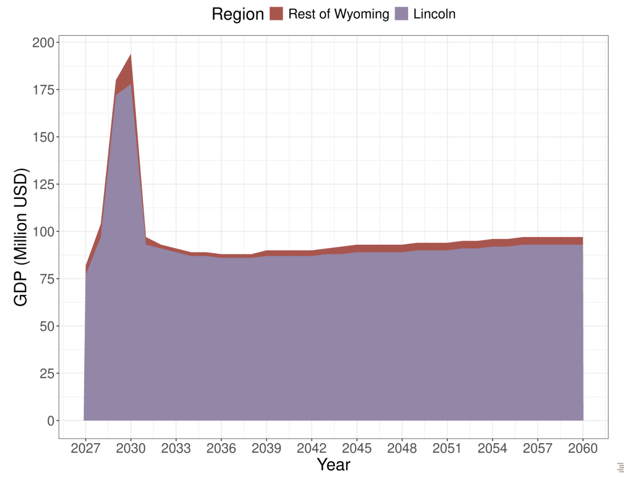
Figure 3. Annual modeled GDP impacts in Lincoln County and the rest of Wyoming, in millions of U.S. dollars. Source: Economic Impact of Data Centers, GDP, slide 15. The dollar price year is unspecified.
During operations, annual GDP impacts settle into the high $80 millions before gradually increasing toward approximately $97 million by 2060. Lincoln County receives most of the contribution. At the 2030 peak, its portion is approximately $179 million, with around $16 million occurring elsewhere in Wyoming.
Spillovers outside Lincoln County later stabilize near $4 million annually. The county-level results identify Uinta, Teton, Sweetwater, and Sublette individually, illustrating how economic relationships extend beyond the host community. Although these contributions are smaller than Lincoln County’s, they still represent several million dollars in annual activity elsewhere in the state.
Efficiency gains help explain why GDP increases over the longer term while total employment declines somewhat. The post-construction reduction therefore does not imply a return to pre-development activity. GDP measures value added, which differs from capital expenditure, company sales, and tax receipts. Equipment imports also limit how much investment-related activity Wyoming retains.
Tax Incentives and Fiscal Impacts
Fiscal effects depend on the interaction between taxable activity, equipment exemptions, and government spending. The Tax-PI analysis uses revenue and expenditure relationships calibrated with the Wyoming Economic Analysis Division. Changes in economic activity affect revenue sources, which influence public spending and feed back into the regional economy.
The fiscal modeling accounts for exemptions covering computing, power generation, battery, and air filtration equipment, as well as the tax treatment of purchases from other states. These details matter because the origin and tax status of major equipment purchases can change the revenue retained locally even when the overall investment remains the same.
Comparing tax receipts with and without exemptions helps assess their fiscal effect, conditional on the investment occurring in both cases. That comparison does not determine whether incentives caused the developer to choose Wyoming. The available findings therefore do not establish an incentive break-even year or quantify the project’s net fiscal benefit.
Implications for Community Planning
Construction creates the largest temporary surge in employment and GDP, while operations sustain a smaller workforce and continuing economic activity. Housing and infrastructure planning need to account for that transition, especially where multiple large projects overlap in a small community.
Public-service requirements for roads, schools, and policing require a separate assessment; those costs were not quantified in this example. REMI’s migration outputs and appropriately defined regional geography can support further analysis of population changes and service demands. For a specific proposal, matching actual staffing, energy arrangements, equipment sourcing, and tax treatment to local conditions is essential to understanding the benefits communities can expect over time.
Sources
Economic Impacts of Data Centers — REMI webinar event page
The Lincoln County results describe an illustrative scenario informed by confidential project work.