
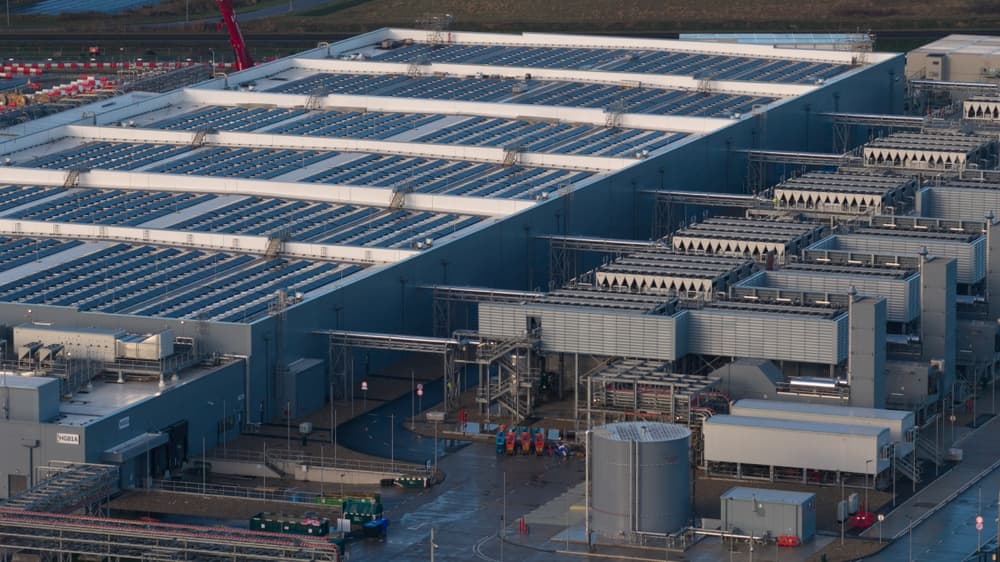
Study Overview
Data centers provide the infrastructure behind cloud computing, artificial intelligence, digital communications, and online services. Their development also affects regional economies through construction spending, equipment purchases, employment, supply chains, and tax revenue.
In The Community and Economic Impacts of Data Centers, Curtis Dubay from the U.S. Chamber of Commerce used REMI PI+ to evaluate the economic impacts of building and operating a 50-megawatt data center. The study examines how data center investment affects employment, gross domestic product (GDP), personal income, and labor force participation across all 50 states. Click here to view the full study.
Key Findings: Employment, GDP, and Personal Income
The analysis includes 50 separate state scenarios, each modeling a new 50 MW facility through a two-year construction phase and a 20-year operating period. The report estimates the following average annual impacts on the host state:
| Economic indicator | Construction phase | Operational phase |
| Employment | 5,220 jobs | 740 jobs |
| Labor force | 1,700 additional participants | 750 additional participants |
| State GDP | $680 million | $175 million |
| Personal income | $400 million | $125 million |
These figures represent economy-wide impacts within the host state, including effects on suppliers and businesses supported by household spending. They are not estimates of employment at the data center itself. The study assumes 50 on-site workers annually during operations, alongside additional utility staffing.
Data center construction also supports economic activity beyond state boundaries. Including the host state and the rest of the country, the report estimates that one 50 MW facility supports approximately 10,600 jobs and $1.6 billion in GDP annually during construction.
How REMI PI+ Supports the Analysis
The Chamber used REMI PI+ to connect data center investment with changes throughout the regional economy. The model integrates input-output, computable general equilibrium, econometric, and economic geography methodologies to produce annual economic forecasts and policy simulations.
This dynamic economic modeling approach captures more than the initial construction expenditure or direct facility employment. It accounts for relationships among business demand, labor and capital needs, population, compensation, prices, and regional competitiveness.
For this study, the modeled investment included $1.69 billion during construction, covering the building, computing equipment, supporting infrastructure, and utility upgrades. Operational assumptions included staffing and $1 billion in computer, server, and electronic equipment replacements every five years.
REMI PI+ traced how these investments affect construction firms, equipment suppliers, service providers, and other industries. It also captured additional economic activity as workers spend income and businesses respond to changing demand. Results were reported separately for the host state and the rest of the country, demonstrating how regional supply chains influence where economic benefits occur.
Data Center Tax Revenue and Fiscal Impacts
The study also examined potential tax revenue associated with a new 50 MW facility in four representative counties. Estimated gross revenue over five years ranged from approximately $96 million in Franklin County, Ohio, to $174 million in Dallas County, Texas.
For this fiscal analysis, the Chamber used REMI outputs for consumer spending, residential property values, and business structures and equipment, then applied relevant tax rates.
These figures are approximate gross revenue estimates, rather than net fiscal benefits. Actual collections depend on local tax rules, depreciation, exemptions, and negotiated abatements. Some calculations include combined state and local sales tax rates.
Implications for Regional Economic Development
The findings illustrate how data center development can influence employment, household income, infrastructure investment, and the tax base over time. They also demonstrate why project-specific economic impact analysis matters: regional industry composition, workforce availability, and supply chains affect the scale and distribution of results.
The report emphasizes that economic benefits should be considered alongside electricity demand, water use, land use, traffic, noise, and other community concerns. Its statewide estimates provide a starting point for understanding potential impacts, rather than a substitute for evaluating an individual project.
For policymakers and economic development professionals, REMI’s dynamic modeling framework helps explain how a major investment moves through the economy—and how its effects evolve from construction to long-term operations.